Folks, don't forget that we have an extremely comfortable iOS application in App Store
Please try it!

Taktsang Lakhang Monastery
Taktsang Lhakhang Monastery is a Buddhist temple located in a high mountainous area and striking with incredible panoramic views of slopes, gorges, passes and peaks.
The abode is erected in such a way that it seems to float in weightlessness, while remaining the epitome of spirituality and strength. This place is advised when travelers ask what to see in Bhutan for a touch of mystical customs and deep inner relaxation.
Several observation platforms are arranged especially for tourists, you can admire the mountain peaks from the balconies.
Duntse Lakhang Monastery
Duntse Lakhang is an ancient Buddhist monastery in the shape of a chert, which is very unusual for Bhutanese architecture.
The temple has a huge collection of ancient Buddhist icons and belongs to the Drukpa Kagyu school. The monastery was built in 1421 and was initiated by Tangtong Gyelpo, a famous lama also known by the name of Chagzampa.
The decoration of the temple is considered unique - icons and paintings are of great value. On the first floor of the monastery, there are five meditating figures of Buddha as well as figures of deities Padmasambhava, Tangtong Gyelpo and Avalokiteshvara.
Bhutan National Library
One of Bhutan's most popular sites is the Bhutan National Library, established to disseminate and preserve Bhutan's rich cultural heritage. It was inaugurated in 1967 on the initiative of Queen Asha Choden.
The library was originally housed in the central tower of the Tashicho Dzong. It had a small collection containing precious texts. Soon it had to be placed in a separate room because of the rapid growth of the collection. It was a four-story octagonal complex in the traditional dzong style.
In 2004, an additional building was added to the library, which houses state documents and national archives equipped with modern technology. It also houses ancient letters and photographs. The archive has a special microfilming service that ensures the long-term preservation of documents and books.
Punakha Dzong Complex
Punakha Dzong is a traditional-style complex that serves both a protective and spiritual function. The monastery was built in the 15th century in the place where the two rivers Pho Chu and Mo Chu join, and to prevent the enemy from attacking undetected, the builders provided only one way to the fortress - a steep stone staircase.
Additional protection for the inhabitants is provided by a large, sturdy gate. Standing at an altitude of 1200 meters, the structure reflects the greatness of Buddhism and the talent of the architect who managed to create an impregnable fort with an elegant visual appearance.
Paro Town
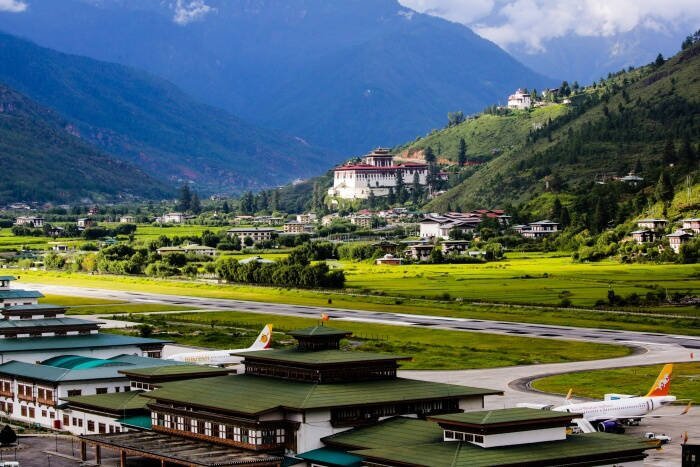
Paro Town is a famous landmark in Bhutan, located in the valley of the same name and characterized by an ancient history.
For many centuries, it was through this settlement at an altitude of about 2,500 meters that the only way to Tibet, which is a sacred kingdom for Buddhists, passed. Up to our times almost virgin buildings with unique interior decoration and unique paintings have been preserved. Paro is the leader among Bhutanese cities in terms of prosperity.
Subscribe to our telegram channel @tripmydream to be the first to hear travel news and promotions!
Trashi Cho Dzong Monastery
The residence of the Supreme Lama of Bhutan. Government and court sessions are also held here. Local monks do not lead a reclusive life. They actively communicate with the population, organize children's festivals and preach their religion.
Entrance for tourists is open during the Thimphu Tsechu festival, when interesting shows and performances are organized especially for guests.
Thimphu Chorten
One of the most visited attractions in Bhutan's capital, Thimphu.
The temple was built in the 70s. 20th century in honor of the third king of Bhutan, who was believed by his subjects to be a saint. Inside the building is an altar with the deity Buddha Samantabhadra, and on either side are other deities in mournful poses.
In 2008, the temple was restored and the grounds were beautified and expanded.
Drukgyal Dzong Fortress
Drukgyal Dzong Fortress is the ruins of an ancient settlement in the western part of the country, which was an important strategic site in the past.
Like most local buildings, it is both a Buddhist monastery and fortress, and Drukgyal-dzong was built after a great victory over neighboring Tibet dating back to the 17th century.
Unfortunately, now most of the fortification complex is in a deplorable state - there was a large-scale fire in the middle of the last century, and the local authorities have not yet carried out reconstruction.
Manas National Park
The Royal Manas National Park is the oldest national park in Bhutan, founded in 1966. Its area is about 1,057 square kilometers.
The park is home to elephants, gaur, Bengal tigers and is also home to rare golden langurs, pygmy pigs, bristle hares and Gangetic dolphins.
The Royal Manas National Park is the only place in Bhutan where Indian buffalo and Indian rhinos live. It is also home to hundreds of bird species, the most exotic of which are hornbills, wavy kalao, Nepalese kalao, toques and dwarf kalao. Rare fish live in the tributaries of the Manas River.
Auto excursions are organized for tourists.
Tango Monastery
Tango Buddhist Monastery is located 14 kilometers north of Thimphu, the capital of Bhutan. It was built in the XIII century by the religious figure Lama Gyalwa, but it acquired its present form in 1688.
Unique here are the caves, where meditations were conducted since the beginning of XII century. Near the temple there are prayer wheels made of slates. Inside the courtyard there is a gallery illustrating the life and work of the national hero Drukpa Kagyu.
On the first floor of the Tango Monastery is a statue of Buddha made of gold and copper.
Dordenma Buddha
Buddha Dordenma is one of the newly created attractions in Bhutan (built in 2010) that cannot be overlooked.
Buddharupa of Shakyamuni Buddha with a height of more than fifty meters ranks 23rd in the world among existing statues, and for its construction had to pay about a hundred million dollars. The statue is a temple on the grounds of the ruined palace complex of Sherab Wangchuk and has a gold finish, and inside there are more than a hundred sculpted images of the saint with a precious coating. The decoration of the temple makes an unforgettable impression with its opulence.
You can book a hotel in Bhutan with a discount of up to -65% on the website.
Jigme Dorji National Park
One of the main natural attractions in Thimphu, the capital city of Bhutan, is Jigme Dorji National Park, which is the largest protected area in the country. П
The park is named after Jigme Dorji Wangchuck, the third king of Bhutan. It is home to about 6,500 people who are mainly engaged in agriculture. The park is home to rare animals like the Himalayan bear and the irbis. There is also a center of geothermal activity, the largest in Bhutan, as well as many historical monuments.
Fans of outdoor activities can choose one of the hiking trails to admire the local scenery, observe the life of exotic animals in natural conditions and take wonderful photos.
National Museum of Bhutan
The National Museum of Bhutan is part of a dzong dedicated to exhibits related to the Buddhist religion, the history of its development and saints.
Many pilgrims and ordinary visitors from other countries come here, for whom the specially equipped building houses many unique exhibits, and among them there are those that allow you to immerse yourself in the everyday life of the Bhutanese people.Take out insurance for traveling abroad in a couple of clicks!