Guinness World Records Museum
To the unique attractions of Denmark, undoubtedly, we can include the Guinness World Records Museum in Copenhagen, created on the initiative of one eccentric man, caricaturist Leroy Ripley. He became famous all over the world thanks to his incredible collection of exhibits, which he collected for a long time, traveling around the planet.
On the area of 1000 square meters there are expositions testifying about 500 world records in different spheres of life, registered at different times in different places. All exhibits are in one way or another connected with the famous Guinness Book of Records.
Museum of Modern Art
The Museum of Modern Art is what to visit in Denmark is a must if you find yourself in central Jutland. The fact that the main concept of the museum was its internal organization on the principle of the circles of hell, purgatory and paradise described in Dante's "Divine Comedy". Thus, the visit starts from the lower floors with the infernal entourage, and the top of the building is crowned with a transparent rainbow halo, from inside of which you can observe the surrounding panorama of the city.
Here you will meet a lot of expositions - amazing, fascinating, striking, frightening and even shocking - all this is concentrated on the area of the museum of 17 thousand square meters.
Legoland
In the small town of Billunn, the Danes have created a wonderland - LegoLand. Every child at least once in his life has heard about it and dreamed of going there. And even adults here take a breath away from what they see.
The park occupies an area of 100 000 square meters and consists of 8 zones. For the construction the creators needed about 50 million cubes. The Duplo zone with a soft surface is open for the youngest ones. A train rides through the fairyland, there is a children's driving school and a functioning fire station, which is also made of Lego cubes.
Frederiksborg Castle
The famous king of brewers Carl Jacobsen became the founder of the museum in Frederiksborg Castle in the town of Hillerd, which made the life and history of the Danish kings tangible for an interesting audience of tourists.
This palace is a kind of symbol of the monarchy that has never interrupted Denmark. In the center in front of the castle is the fountain of Neptune. The walls are richly decorated with sculptures, columns, bas-reliefs. All monarchs of Denmark were crowned in the castle chapel.
Bornholm Island
The pearl of the Baltic Sea, the island of Bornholm is famous for its excellent beaches and mild climate. Cherries, apricots and walnuts grow here, and the inhabitants are skilled glassblowers.
The island surprises with its diverse landscape. Mountains, fields, forests, hills and even white sand dunes will delight experienced travelers. Round churches and windmills have become a trademark of the island.
Old Town in Aarhus
In the botanical garden of Aarhus is an open-air city-museum. The creators brought here old houses from all over Denmark, reproducing them in the smallest detail. Powerful narrow streets, a mint, a port, mills, workshops that work and offer to buy products, "residents" dressed in ancient clothes - as if you are transported to the distant past...
Isle of Man Chalk Cliffs
The chalk cliffs of the Isle of Man, also known as the Maine Cliffs, are one of Denmark's major natural attractions. They were formed several million years ago as a result of the movement of glaciers replacing chalky rocks. The white cliffs stretch for about 6 km along the coastline, and their highest point, Dronningestolen, is located at 128 meters above sea level.
The attraction can be viewed either from a boat or in close proximity to the cliffs themselves. There are hiking trails with stairs to the sea almost all over the area that the cliffs occupy. There is also a museum where you can learn about the history of the area in an interactive format.
Egeskov Castle
Egeskov Castle, standing in the middle of the lake, was built in the middle of the 16th century. Legend has it that a whole oak forest was cut down to create the foundation consisting of wooden piles, which gave rise to the name "Egeskov" (oak forest).
Nobles have not lived here for a long time, so the castle is open as a museum for all lovers of Western European history and architecture. In addition to the usual castle paraphernalia of the past centuries, Egeskov has unique collections of antique cars, motorcycles and even flying machines.
Faroe Islands
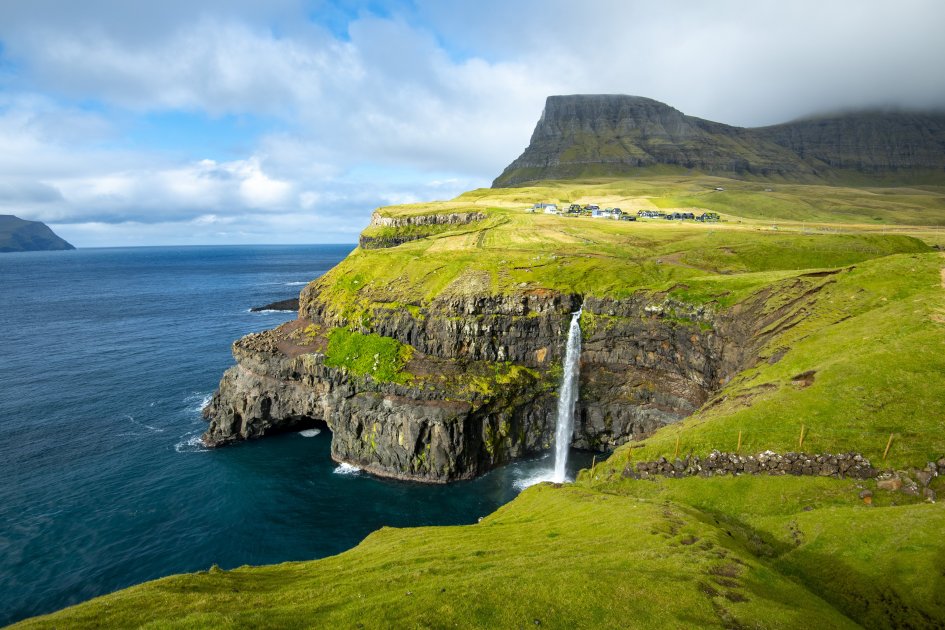
Rounding out the selection are the Faroe Islands, located in the middle of the Atlantic Ocean thousands of kilometers from mainland Denmark and is not the most accessible territory, so it attracts mostly experienced travelers.
What to see in the Faroes? You should start with the island of Fugloi, which is home to a multi-million colony of seabirds. Then be sure to check out the steep cliffs and caves of Kalsoy Island, walk the sand dunes of Sandoy Island, feel the spirit of history at Munkastovan Monastery, and be sure to see the famous houses with grass sprouting instead of the usual roofs.
Although the Faroe Islands belong to Denmark, they feel like a completely different country, cut off from the rest of the world. If you've ever wanted to get away and live in the midst of unbelievably beautiful nature, the Faroes are the perfect place.