St. Augustine's Church
Since you are already in the capital, we tell you that the most famous religious building in the country is also located in the city of Manila. We are talking about the Church of St. Augustine, which was completed in 1607.
The arch of the church is decorated with magnificent sculptures depicting lions, and in the niches you can see statues of saints. The main decoration of the premises was a beautiful ceiling, which was painted by famous Italian masters.
Church of Baclayon
Baclayon Church, officially known as the Church of the Immaculate Conception of the Blessed Virgin Mary, is one of the oldest Catholic churches in the Philippines. Located in the picturesque province of Bohol, this historic church is a symbol of the country's rich cultural and religious heritage and a place of pilgrimage.
The shrine was founded in 1596 by Spanish Jesuit missionaries, making it one of the first Catholic churches in the Philippines. It is still an excellent example of Baroque architecture with elements of local traditions. Its massive walls, high vaults and decorative elements reflect the influence of the Spanish colonial era.
There is a museum on the grounds of the church that houses many historical and religious artifacts. These include antique books and manuscripts, religious relics including statues of saints and church utensils, antique furniture and musical instruments, and much more.
Orchid Gallery
Another attraction of the capital is the Orchid Gallery. The park is located in the very center of the city, 10 years ago it was just an ordinary parking lot.
Today it is an original interweaving of cozy paths, observation platforms, bridges, flowerbeds and trees. There are several miniature waterfalls, fountains and artificial lakes in the park. Carved benches, sculptures and gazebos can be seen everywhere. The most interesting place of the park is the butterfly pavilion, opened on the initiative of the world-famous Nokia company.
Ayala Museum
Located in the heart of the Makati business district in the nation's capital, the Ayala Museum is one of the Philippines' most famous cultural institutions. This state-of-the-art museum combines art, history and innovation to provide visitors with a unique opportunity to explore the country's rich culture and heritage.
The museum exhibits include gold collection, modern art, maritime society, etc. A visit to the Ayala Museum will be an unforgettable experience for art lovers, history buffs and those who want to gain a deeper understanding of Filipino identity.
Mayon Volcano
Mayon Volcano in the Philippines is considered one of the most beautiful volcanoes in the world. Unlike other volcanoes in the Philippines, Mayon has a regular cone-shape, and at its summit you can almost always see smoke billowing into the sky.
Despite centuries of history, Mayon Volcano remains active and can surprise you with an eruption at any time. If scientific studies are to be believed, this Philippine volcano has erupted more than 50 times in the last 400 years! But these gruesome facts only seem to attract today's tourists who want to climb the troubled mountain more.
Boracay's White Beach
It's no secret that the Philippines has also been embraced by beach lovers, so the country's luxurious beaches are perfect for this type of relaxation.
So lovers of perfect bounty-style beaches will love Boracay's White Beach. It is located on the west coast of the island and occupies more than 4 km in length and 100 meters in width. It is here that the main hotel, entertainment and shopping infrastructure is concentrated.
Conventionally, it is divided into three parts according to the numbers of boat stations. The first - the northernmost, is characterized by snow-white sand, in consistency similar to flour, and a long shallow water. It is also home to expensive hotels and restaurants.
Bulabog Beach
Bulabog Beach is one of the most popular places in the world for kiting and surfing. The wind, which blows most of the year, and the shallow seabed contribute to this.
International competitions are held here, attracting athletes from all over the world. If you are looking for privacy or going with children and do not plan to "catch the wind and wave", it is better to choose other beaches, there are many of them in the Philippines. However, once to look at this bright adrenaline extravaganza is worth it. Consider it as a place of rest is worth considering only if you plan to engage in water sports.
Molokonang Palace
The Malacanang Presidential Palace in Manila is a vivid representative of Spanish colonial architecture. Its image harmoniously combines the refinement of the Baroque with the restraint of the later Neoclassical style. Located among green gardens on the banks of the Pasig River, Malacanang was originally a favorite residence of the viceroys of the Philippines.
The complex was built in 1750. Since 1863, 18 Spanish viceroys have lived and worked here, and since 1946, presidents of the Republic of the Philippines. In the 20th century, during the turbulent years of protests and the struggle for independence, the palace was bombed and seized several times by rebels.
The village of El Nido
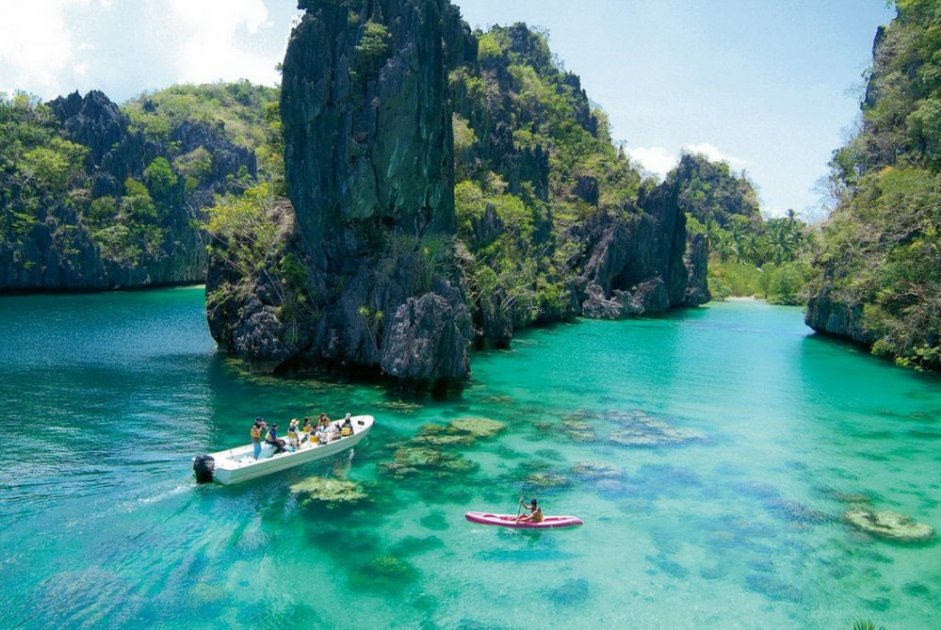
This place has hardly changed since the early colonial years. Standing on the white sandy coast to the west you can admire the many small islets, which in turn form a network of lagoons and canals. The transparency and clarity of the Philippine waters is mesmerizing.
You can also easily rent a boat for a whole day for about twenty or thirty dollars. A local resident will open a picturesque route, tell you about the best places for swimming, give you plenty of wild beaches and will certainly "treat" you to an amazing dish - grilled seafood.
Rice Terraces
The largest of the islands in the Philippines is North Luzon. In the very center of this island is a haze-shrouded mountain range, and a pine forest replaces the palm groves that many vacationers have grown accustomed to.
In this area, on the slopes of green ravines are rice terraces, which are about two thousand years old! In some places there are even settlements belonging to people from ancient tribes. They still shun strangers, try to live in isolation and are reverent to the traditions of their people. Excursion trips are available here, including walks along rice terraces, visiting local villages and admiring waterfalls.
Kawasan Waterfalls
Kawasan Waterfalls is a three-stage cascade of clear water from mountain springs located in the jungles of Cebu Island, belonging to the Philippines.
The waterfall itself will make a great impression on tourists who prefer ecotourism, as well as lovers of exoticism and extreme sports, because you can get to Kawasan only for half an hour wading along a narrow path through the humid tropical jungle. This small journey can be a real adventure, especially for people who have not been in the jungle before. An impenetrable thicket of lianas, ferns, more than two meters high, unbearable humidity and the need to cross three bridges hanging over the abyss turn an ordinary excursion into a fascinating attraction.
Intramuros
Intramuros is Manila's historic center and oldest neighborhood, with stone churches, monasteries, maidans and baroque architecture. It is cordoned off by stone walls that the Spanish built to protect the city and used for three centuries. Behind the fortress walls were the homes of wealthy residents, churches, schools and government buildings.
Today, Intramuros is an open-air museum whose setting transports you back in time. You can join a walking or bicycle tour to ride a bamboo bike and explore the main historical sites.
Book a hotel in the Philippines with up to -65% discount on the website.
Jose Rizal Park
One of the oldest city parks in Asia is the Jose Rizal Park. This place was named after a famous Filipino figure of the XIX century.
And in 1946, it was in this park that the country's independence was declared. Other attractions include the Jose Rizal Monument, the Independence Flagpole, the Japanese and Chinese Gardens, the National Library of the Philippines, the Orchid Orangery and the Butterfly Pavilion.
In 2008, Manila Ocean Park was opened in the Jose Rizal Park. The main local attraction is the 25-meter-long Living Ocean Tunnel, whose walls bend at a 220-degree angle. Manila Ocean Park itself is divided into several themed zones.
Palawan Island
Jungles, mangroves and mountains are the main natural characteristics of the island of Palawan, which began to be inhabited in the 12th century. Today, visitors come here to stay in luxurious eco-hotels, go diving and trekking, and visit the famous Tabon Caves, where the remains of ancient humanoid creatures have been discovered.