Travel Ideas

Tbilisi in winter: what to see, where to go

Tbilisi in winter is an amazing combination of mild climate, festive atmosphere, and no summer crowds of tourists. In winter, the Georgian capital is decorated with New Year's lights, the smell of mulled wine and cinnamon is everywhere, and Christmas markets are held in the streets. This is a great time to enjoy the color of the ancient city without the hustle and bustle and queues – to walk in comfortable weather, try seasonal treats, and see the city as the Tbilisi locals know it. In this guide, we will tell you what to see in Tbilisi in winter and where to go to make your trip truly rich and soulful.
20 february 2026
AUTHOR: Kateryna Lindt
0
20 min

Folks, don't forget that we have an extremely comfortable iOS application in App Store

Please try it!

Kateryna Lindt
I write routes the way I would advise a friend before a trip - nothing superfluous, just proven and at a comfortable pace.

The average temperature in Tbilisi in winter ranges from +0 to +8 °C, and temperatures below -5 °C are extremely rare. Snow cover is uncommon, and locals consider even zero degrees to be bitterly cold.

Walks through Old Tbilisi

The best place to start exploring the city is Old Tbilisi, a historic district that turns into a magical labyrinthin winter . Narrow cobbled streets with carved balconies, sometimes dusted with snow, transport you back to centuries past. During the day, you can wander endlessly through the alleys, looking at old houses and peeking into courtyards (front doors) in the Sololaki district—many of them still retain the grandeur of merchant mansions with twisted cast-iron staircases and paintings on the walls. Even in winter, life here goes on as usual: grandmothers chat on benches in the courtyards, many houses still have wooden balconies, and somewhere you can hear the Georgian speech of neighbors. Such a leisurely stroll allows you to feel the local flavor and take atmospheric photos of winter Tbilisi as a souvenir.

Narikala Fortress

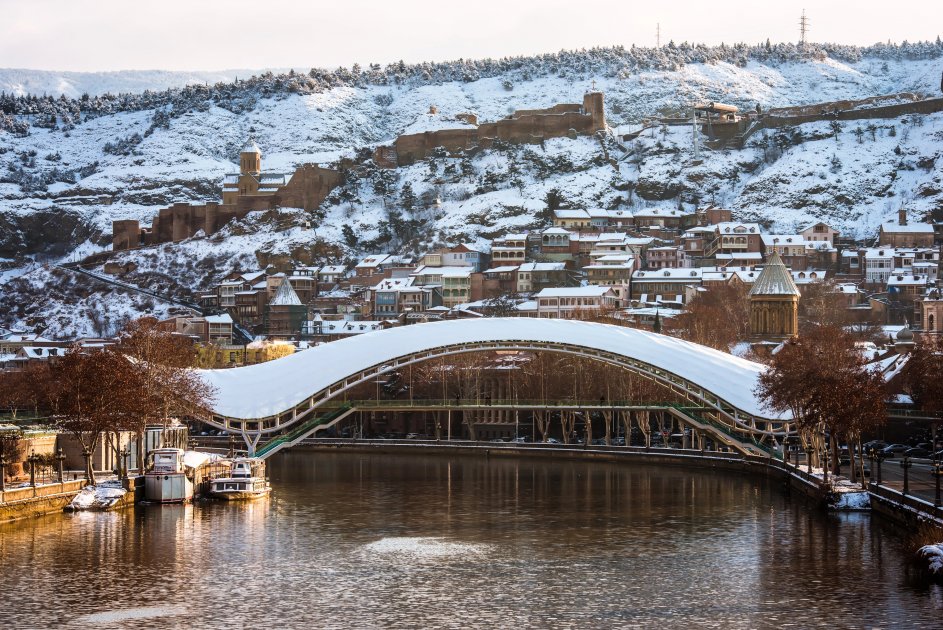
Be sure to climb up to NarikalaFortress , the symbol of the city on top of the hill. In winter, the fortress walls offer a stunning panorama: the city below twinkles with lights, the Kura River is covered with frost in places, and the snow-capped Caucasus Mountains are visible on the horizon.

You can get to the top on foot (about a 20-minute climb) or by cable car from Europe Square—the ride takes only about 3 minutes and costs around 2.5 lari. Once you reach the top, be sure to walk along the old stone walls of Narikala. Light snow gives the fortress a special magic, and the photos taken from here are truly magical.

Next to the fortress stands the aluminum statue of Mother Kartli (Mother Georgia) — another symbol of Tbilisi, which in winter seems to guard the city, holding a bowl of wine and a sword. You can go back down by cable car or on foot through the old Abanotubani district, home to Tbilisi's famous sulfur baths.
Sulphur baths

Sulfur baths are a must-see even in winter. Steam rising from pools of hot mineral water envelops the Abano Terme area in a mysterious haze. You can visit one of the historic baths with domed roofs: the sulfur-rich water is a pleasant way to warm up after a long walk. This procedure improves blood circulation, relieves muscle fatigue, and provides deep relaxation.

The classic thing to do is to go to a public bath late in the evening, when the day is over, and steam with the locals (and order a traditional soap massage and peeling). Tourists note that this is a very colorful experience.

Keep in mind that the famous Blue and Graybaths in Abanotubani are popular, and prices there are higher. According to experienced travelers, you can try the new bath complex on Lake Lisi: it is modern, cleaner, and cheaper, and the water quality is just as good.

undefined
Photo author - bouw

Legvtahevi and Kldisubani Waterfalls

While strolling through the old town, take a look at the small Legvtahevi Waterfall (at the end of Leselidze Street, behind the bathhouse district). In winter, when there are light frosts, the water jets can partially freeze, forming a beautiful ice cascade on the rocks—an unexpected natural corner in the middle of the city.

From there, it's a stone's throw to the Rock District (Kldisubani), where houses literally hang over the river gorge – an impressive sight.

Peace Bridge and Rike Park

Continuing along the embankment, you will soon come to thefamous Peace Bridge, an elegant pedestrian bridge made of glass and steel. At night, its futuristic lighting is reflected spectacularly in the waters of the Kura River. In winter, the bridge's lights, sparkling against the night sky, create a romantic atmosphere. Crossing it to the left bank, you will find yourself in the modern Rike Park, where even in the cold season, whimsical fountains operate and snow may lie on the lawns.

Tip: bring comfortable, non-slip shoes with you—the cobblestones on the old streets can be slippery on rare frosty days. And don't hesitate to peek into the local courtyards: many doors are open, and you can admire the old staircases and stained glass windows of the entrances, which the people of Tbilisi are so proud of.

Panoramic views: Mtatsminda Mountain and the funicular

Mtatsminda

Those who enjoy views should visit Mtatsminda (High) Mountain , the highest point in Tbilisi (approximately 770 meters above sea level). The Tbilisi funicular, built at the beginning of the 20th century, will take you from Republic Square to the top of the mountain in a few minutes. The ride in the old carriage is an adventure in itself.

At the top is the Mtatsminda amusement park, which operates on a reduced schedule in winter, but the main attractions are still available. Be sure to take a ride on the big Ferris wheel, which offers a breathtaking panorama of the capital. On a clear winter day, you can see the entire city at a glance, and in the distance, the snow-capped peaks of the Greater Caucasus. In the evening, when Tbilisi lights up, the view from Mtatsminda is no less beautiful: the TV tower on the mountain shimmers with multicolored lights, and below, the lights of houses are scattered like stars.

Mamadaviti Church and Pantheon of Great Figures

After exploring the site, we recommend walking down one of the trails: on the way, you will see the small Mamadavi Temple and the Pantheon of Great Figures, an ancient cemetery where famous Georgian writers and public figures are buried (Alexander Griboyedov and his wife, Joseph Stalin's mother, and others are buried here). The path will lead you to the city in the area of the old streets, offering several more beautiful views along the way.

Lunch at the Funicular restaurant

If you don't feel like walking down the mountain, you can linger at the top at thefamous Funicular restaurant, drink hot tea or coffee with churchkhela, and admire the panorama through the huge windows before descending back down in the same cable car.

undefined
Photo author - relax

Cable car to Narikala

Another option for enjoying the view is theaforementioned cable car to Narikala. Even if you climbed up to the fortress on foot during the day, it is worth taking a ride in the cable car over the old town in the evening to see the lights: the route is very picturesque, especially when the city is festively illuminated. By the way, the lower station of the cable car is located in Rike Park, next to Europe Square, and operates from approximately 11:00 a.m. to 11:00 p.m. daily (in winter, it is better to check the schedule, but it is usually open until late in the evening). At the upper station, near the fortress, don't miss the opportunity to take a photo with Tbilisi at night in the background—the views are simply postcard-perfect.

Subscribe to our Telegram channel @tripmydream to be the first to hear about travel news and promotions!

Rustaveli Avenue and the city center

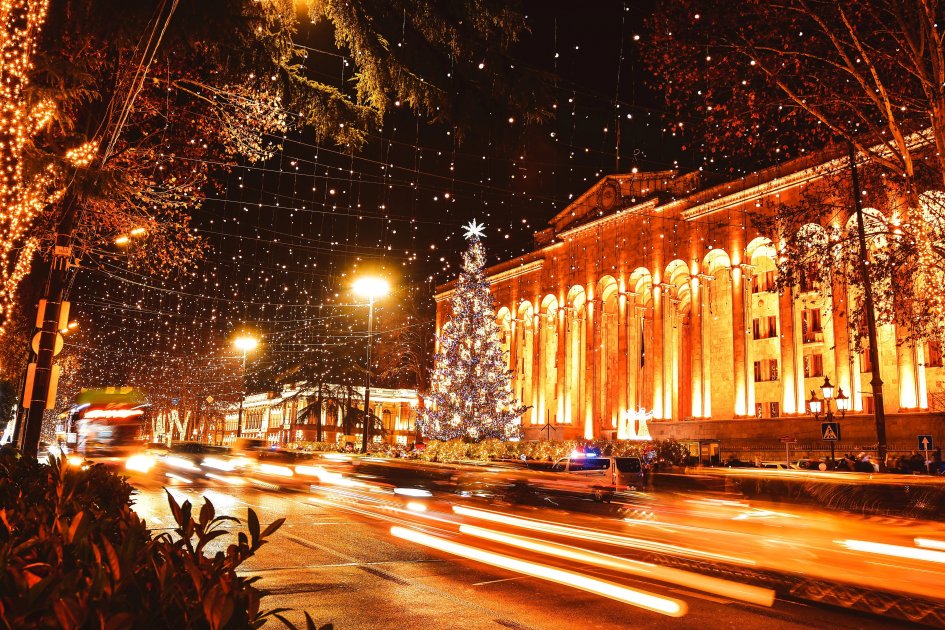
Tbilisi's main street, Shota Rustaveli Avenue, is transformed in winter and shines with lights. It is the city's central artery, about 1.5 km long, and it is worth walking along it at any time of the year. For the New Year holidays, garlands are traditionally hung here, trees along the avenue are decorated with large balls, and even though there may be no snow, the Christmas mood is created by the illuminations. At the beginning of Rustaveli, on Freedom Square, one of the city's main Christmas trees is installed—tall and brightly decorated. And approximately in the middle of the avenue, near the former parliament building (First Republic Square), there is often a large Christmas tree with a shining star on top.

It can be said that New Year's Tbilisi is concentrated right here: around the Christmas trees are festive fairground stalls selling souvenirs, knitted items, treats, and hot drinks. On the street, you can also meet dressed-up Santa Clauses — thelocal Tovlis Babua (translated from Georgian as "Snow Grandfather"), who is happy to take pictures with children for free.

In general, the central part of Tbilisi is quite compact: you can walk from the upper part of Rustaveli to the old town in 20-30 minutes, stopping by the Dry Bridge or a wine bar along the way. There are also many banks and currency exchange offices in this area—in winter, the exchange rate is often more favorable than in the height of summer, so you can exchange currency with minimal loss if necessary.

You can booka hotel in Tbilisi with a discount of up to 65% on the website.

Theaters and museums in the center

While strolling along Rustaveli Avenue, check out the sights: the Opera and Ballet Theater, a beautiful Moorish-style building; the Rustaveli Theater; and the old parliament building with its columns. There are many museums right on the avenue or nearby: the National Museum of Georgia, the Art Museum, andthe Gallery of Contemporary Art. If the weather is bad, you can safely devote your time to their exhibitions. For example, the National Museum has the famous Golden Treasury, and the Art Museum has a rich collection of icons and paintings by Georgian masters.

If your walk has gone on late, you can pop into the Rustaveli Cinema, one of the oldest cinemas in the city. Another option for a cultural evening is to attend a performance at the Rezo Gabriadze Puppet Theater on Vakhtang Square. Even if puppet shows are not your thing, the building itself, with its legendary falling tower, is worth seeing. In winter, atmospheric chamber performances are held there, and tickets are inexpensive (~20-30 lari). Don't forget to check the schedule: in winter, fairy tales and New Year's mini-performances are often staged, which are interesting for both adults and children.

Travelers with children will be interested in the Puppet Museum or the interactive Museum of Illusions, located nearby.

Not far from the puppet theater, by the way, is Orbeliani Square, which in recent years has become one of the main festive locations (more on that below).

Sweets and souvenirs

The avenue is full of cafes, coffee shops, and street stalls. On a cool day, it's nice to pop into a cozy coffee shop for an oriental coffee or a glass of tart mulled wine. By the way, near the Rustavelimetro station , there is a Borjomi brand store where, in addition to the famous mineral water, you can buy a variety of Georgian sweets and souvenirs.

There are many buses running along this street, but we recommend walking so you can see the shop windows with New Year's decorations, street art objects, and feel the rhythm of the city.

Markets

Deserters Market

To get a feel for the local flavor, head to Tbilisi's markets. The largest food market in the city is the Deserters' Market (also known as Dezertirka) near the train station. In winter, it is especially pleasant to stroll through the covered rows of spices, dried fruits, and fresh mandarins brought from western Georgia. Hand-knitted warm socks and everyday clothes are also sold here at very low prices. Incidentally, the market got its name from history: soldiers who had deserted used to trade captured food here.

Be sure to buy churchkhelaat the Deserters' Market , a traditional sweet made from nuts in thickened grape juice. Prices here are lower than in tourist shops: 1 piece costs from 1 to 3 lari, depending on the size and filling. Sellers will always let you try it before buying, and experienced tourists advise choosing churchkhela without a white coating (a sign of long storage).

It is customary to bargainat the market —for example, if you are buying fruit by the kilogram, try to get the price down. Be prepared to check the weight of the goods yourself: according to rumors, some traders tamper with the scales, so it would be useful to check whether the bag really contains the 3 kg you paid for (it may turn out to be a couple of hundred grams less). This little trick will help you feel at home and save you from overpaying.

undefined
Photo author - travel advisor

Flea market on Sukhomost Bridge

Another must-see is the flea market on Sukhoi Most. It is open daily, but is busiest on weekends, starting around noon (officially from ~11 a.m.). Dozens of stalls are scattered under the open sky, offering a wide variety of antiques: from Soviet badges, old cameras, and vinyl records to daggers and silver jewelry. Local artists also sell their paintings and drawings here, which make excellent souvenirs.

Prices for souvenirs on Sukhoi Most are often lower than in the tourist center, and you can almost always haggle. The atmosphere of this market in winter is special: merchants wrap themselves in warm scarves, offering rare trinkets, old music plays, pigeons circle above the bridge... Even if you don't buy anything, it's worth taking a walk just for the atmosphere. And if you're lucky, you can find a truly unique item with a history. Many tourists leave the Dry Bridge with vintage Christmas tree decorations, old books, or even paintings as souvenirs of their trip.

In addition, Christmas marketsare open in the city in December (more on them later), where you can also buy souvenirs and gastronomic gifts: honey, teas, spices, handmade toys. And everywhere, on the streets, you will encounter sellers of homemade wine in plastic bottles, churchkhela, and hot corn — support the locals by trying their products, it's also part of the experience.

Georgian cuisine: what to try in winter

Georgia is famous for its cuisine, and winter in Tbilisi is the perfect time to sample the most hearty and warming dishes. Start with khinkali, juicy dumplings in broth. On a cold day, khinkali with meat and spices, topped with cheese sauce, or stuffed with mushrooms (for vegetarians). Visit one of the khinkali restaurants (for example, the Samikitno café chain in the Old Town) and order an assortment of different types. Incidentally, the windows on the second floor of Samikitno on Mekhekle Square offer a beautiful view of the Vakhtang Gorgasali monument and the Metekhi Church. Khinkali here cost about 1 lari each, so you can eat your fill for literally 5–10 lari.

Don't forget about khachapuri, hot cheese bread. In winter, Georgians especially love rich kharcho (spicy soup with beef and rice) and chakhokhbili (chicken stew in tomato and wine sauce), and for dessert – fragrant tea with paradise apple jam or a cup of strong Turkish coffee. Interestingly, a modern offshoot of Georgian cuisine has become popular in Tbilisi: so-called gastro-khachapuri, where traditional recipes are reimagined by chefs. For example, they add unexpected ingredients to the filling. You can try such experiments in some city restaurants (for example, at RadioCafe on Orbeliani Square, which is famous for its gastro-khachapuri).

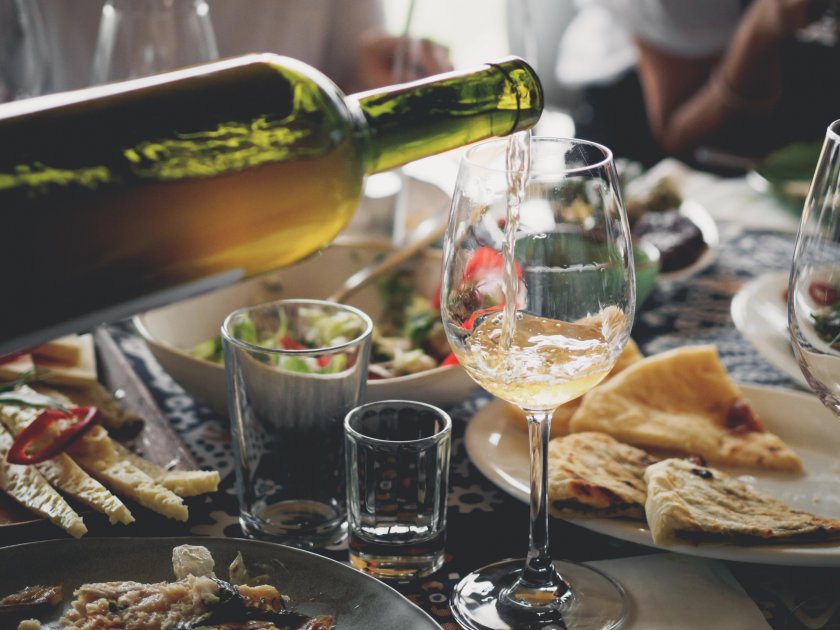
In winter, it is a special pleasure to visit a wine cellar and arrange a tasting of Georgian wines. Georgia is the cradle of winemaking with an 8,000-year history, and traditional wines aged in qvevri (clay amphorae) warm the soul on a cold evening. There are many tasting rooms in Tbilisi where, for a moderate fee (about 5-10 lari for several samples), you will be told about the technologies and given a taste of red Saperavi, amber Rkatsiteli, and white Tsinandali. Often, such gatherings feature a toastmaster who, over a glass or two, will recount legends and propose toasts, adding color to the event.

Gastronomic toursare also popular —for example, going with a guide to the best wine bars or to the market for groceries, and then to a master class on cooking Georgian dishes. In a couple of hours, you will learn how to make khinkali or bake khachapuri under the guidance of an experienced chef, and then, of course, taste everything. Such courses are especially popular with family tourists, and in winter there are often discounts.

Another interesting idea is to go to a real Georgian supra (feast). Some agencies or restaurants organize evenings for tourists with a tamada who leads the feast, national dances, and a full range of dishes. This is an opportunity to try all the best dishes at once, from suluguni cheese and pkhali (vegetable appetizers with nuts) to mtsvadi shashlik, and to experience the spirit of Georgian hospitality. The main thing is to come hungry! By the way, your appetite will grow faster in winter, so eat without hesitation: Tbilisi in winter is made for gourmets.

Don't forget about sweets: in addition to churchkhela, during the New Year period in Georgia, they make kozinaki – bars made of walnuts in honey. They are traditionally served on New Year's Eve, wishing for a sweet life. You can buy them in pastry shops or at the market, or try homemade ones if you are lucky enough to visit someone's home. Dried fruits, churchkhela, and tklapi (fruit paste) are also sold everywhere—all of which make excellent souvenirs for friends and family.

Winter holidays and entertainment

What else is there to see in Tbilisi in winter but festive events? Winter holidays in the capital are celebrated in style.

Christmas markets

Christmas markets and townsbegin operating in the city in mid-December . The main Christmas market opens annually around December 15–16 and lasts until January 7, just in time for Orthodox Christmas.

In recent years, the renovated Orbeliani Square has become the center of the holiday: it is home to anentire "New Year's village" with food courts, a concert stage, and rows of shopping tents. You can try street food—from shashlik and khinkali to European waffles and mulled wine—and buy beautiful handmade souvenirs from local startups: natural products, jewelry, toys, and accessories.

Even the finalists of the Georgian show "MasterChef" are taking part in the festival, so you will find unusual signature dishes at the fair. Every evening, Orbeliani is filled with music, street theater, and performers. And right in the center of this festive bustle, under the garlands, there is a cozy cafe (the very same RadioCafe) where you can warm up and continue your walk.

In addition to Orbeliani, the fun also takes place on First Republic Square (near the parliament): a huge Christmas tree is installed there, and the Tbilisi Winter Fest is often held —a festival with concerts, a fair, and entertainment for children.

undefined
Photo author - sputnik

Christmas and New Year

On New Year's Eve, the central streets are closed to traffic, and thousands of people walk around, waiting for the clock to strike midnight. At midnight on December 31 , there is a colorful fireworks displayon Freedom Square, after which the festivities continue until almost morning. Tourists should, of course, conserve their energy and dress warmly if they decide to celebrate New Year's Eve outdoors: although the climate is mild, the temperature can drop to around zero at night, and you will have to wait for the clock to strike for more than an hour.

Interestingly, Georgia celebrates two Christmases: December 25 (Catholic, more symbolic) and January 7 (main, Orthodox). On January 7, many residents go to church for a festive liturgy, and in the afternoon , a colorful procession called"Alilo" takes place along the central streets , with clergy and lay people in national costumes singing Christmas carols and collecting donations for the needy. If you are in Tbilisi on this day, don't miss the parade—it is a very unique spectacle.

undefined
Photo author - georgianholidays

Where to go in the evening

For those looking for places to go in Tbilisi in the evening during winter, there is a wide range of options besides street festivities. You can visit one of the concert halls, such as the Tbilisi Concert Hall or Event Hall, which often host New Year's shows, jazz festivals, and performances by pop stars. Classical music lovers are recommended to go to a performance at the famous Tbilisi Opera and Ballet Theater —the building itself is luxurious inside, and during the holiday season, they perform The Nutcracker ballet or The Christmas Carol opera. It is best to buy tickets in advance online or at the theater box office.

If you want a more informal pastime, check out the program at the Buffet bar or Art-Cafe Home —these establishments are known for their live music and parties, and often host themed evenings for New Year's Eve.

Family tourists will enjoy the open-air ice rink (often flooded during the winter holidays, for example, on Europe Square or near the Galleria shopping center), where you can skate to music and fairy lights.

Shopping

And, of course, there's no escaping shopping during the winter holidays: from the end of December, many shopping centers (Tbilisi Mall, East Point, etc.) start their sales. So you can spend the day shopping—the prices are pleasantly lower than in summer, and you can warm up indoors at the same time. However, there are also unusual alternatives to malls in the city center – the Fabrika design market in the Marjanishvili district, where former industrial buildings now house youth cafes, shops selling local brands of clothing, and galleries. In winter, a Christmas tree is put up in the Fabrika courtyard and gift markets are held—stop by if you're in the neighborhood.

Trips from Tbilisi in winter

If you have a couple of extra days, be sure to take a trip outside Tbilisi – winter opens up additional opportunities.

Mtskheta

First, visit the ancient city of Mtskheta, the former capital of Georgia. It is located only ~20 km north of Tbilisi, and the minibus ride takes 30-40 minutes. Mtskheta is famous for its majestic Svetitskhoveli Cathedral (11th century), the main temple of Georgia. In winter, surrounded by bare trees and sometimes a light blanket of snow, the cathedral looks especially majestic, both inside and out. There are few people, so you can take a leisurely stroll around the courtyard and soak up the spiritual atmosphere.

On the mountain above the city is the JvariMonastery (6th century), which offers a view of the confluence of the Aragvi and Kura rivers, described by Lermontov ("where, merging, the streams of the Aragvi and Kura rush"). In winter, the rivers are full, the banks are covered with frost, and the picture is picturesque. The Jvari Monastery is about 5 km from Mtskheta. It is best to take a taxi from the cathedral or go directly from Tbilisi to both places by taxi, which is inexpensive (about 50 lari per car). A visit to Mtskheta and Jvari can easily be done in half a day.

undefined
Photo author - sputnik8

Gudauri Ski Resort

For fans of mountain scenery, we recommend a trip to the Gudauri Ski Resort. Even if you don't ski, it's worth it to see the snow-capped peaks and breathe in the frosty mountain air.

Gudauri is located about 120 km from Tbilisi (2–2.5 hours drive along the Georgian Military Highway). There are no direct buses, but you can go on an excursion or take a transfer, which are easy to book, especially during the season. The road itself is picturesque: you will pass the Zhinvali Reservoir, the Ananuri Fortress, and climb the serpentine roads to the Cross Pass. In winter, everything around is white.

In Gudauri, you can rent equipment and try skiing down one of several slopes—there are both easy ones for beginners and difficult ones for pros. There are also simple snow activities: sledding, snow tubing, and photo shoots against the backdrop of the mountains.

Keep in mind that Gudauiri is very crowded on weekends (both locals and tourists come here), so it's better to go on weekdays.

Kodi Ski Park

If you don't want to travel far, there is a small ski park called Koodinot far from Tbilisi (30 km away, near the village of Bakuriani, not to be confused with the large resort of Bakuriani) – there are a couple of slopes for amateurs open in January and February.

undefined
Photo author - tonkosti

Kakheti, Sighnaghi, and Bodbe Monastery

Curious wine connoisseurs should consider a trip to Kakheti, a wine-producing region east of the capital. In winter, the vineyards are bare, of course, but the wineries are open for tours. As part of a one-day tour, you can visit 1-2 wineries, see how qvevri are stored, and taste different wines.

Such trips are usually combined with a visit to the beautiful town of Sighnaghi (also known as the "city of love") on a hill. In winter, Sighnaghi is quiet and romantic, and its observation deck offers a view of the Alazani Valley (when it is not covered in fog).

On the way, you can also visit the BodbeMonastery (where the relics of Saint Nino are kept, surrounded by a wonderful pine forest, sometimes covered with snow). So, the day will be eventful, informative, and delicious.

Borjomi, Rabati, Vardzia

Another destination is Borjomi. This balneological resort is known for its healing mineral waters. In winter, Borjomi Park is fabulously beautiful: the river rushes among snow-covered fir trees, and the snow crunches underfoot on the paths. In the central park, there is a pump room where you can taste warm water straight from the source, and nearby there are historic open-air sulfur baths (yes, Borjomi also has thermal springs!).

However, Borjomi is quite far away—about 160 km from Tbilisi, and the road takes about 2.5–3 hours. But there are "3 in 1" tours— Borjomi+Rabat+Vardzia (a fortress and cave city in southern Georgia) in one day. In winter, they are held depending on weather conditions, but if a group is formed and there is no heavy snow, you can take advantage of the opportunity.

You will see the Rabat Fortress in Akhaltsikhe (decorated with New Year's lights) and the ancient Vardzia Monastery, partially carved into the rock (in winter, it is very quiet and atmospheric there). However, keep in mind that the day will be long and cold, so such tours are not for everyone. If you prefer to take your time, it is better to leave Borjomi and Vardzia for the warmer season.

Useful tips for tourists

  • Clothing and climate: Despite the mild temperatures, bring a warm jacket and shoes with waterproof soles. It can rain in Tbilisi in winter, and evenings and early mornings can be cold (around 0...+3 °C). It is significantly colder in the mountains – for trips to Gudauri, you will need a hat, gloves, and possibly thermal underwear. Not all accommodations in the city have heating: rooms in older guesthouses may be cool, so pajamas are recommended.
  • Transportation: In winter, public transportation in Tbilisi runs on schedule as usual. The metro is a great way to get around (only 1 lari per trip, and the stations are heated). Buses also run, but waiting at the stop can be chilly. Taxis and services such as Bolt/Yandex Go are inexpensive (a trip in the center costs 5-10 lari), which is a lifesaver in bad weather or late at night. The roads in the city are rarely covered with snow, but if it does snow, be patient — traffic jams are possible.
  • Tickets and schedules: Check the opening hours of attractions during the winter. Museums often have shorter hours in winter (for example, until 5:00 p.m.). The cable car to Narikala may be closed for maintenance in windy weather. If you plan to go to the opera or a concert, it is better to buy tickets online in advance, as the halls are small and may be sold out on holidays.
  • Safety: In winter, it gets dark early in the city (around 5:30 p.m.), but it is quite safe to walk around the center—there are many police officers and CCTV cameras. However, it is better not to go to residential areas and parks on the outskirts late at night. Be careful on the mountain roads – in winter, the roads can be icy, so it is best to travel with an experienced driver or as part of an organized tour.

Finances: Winter is the low season for tourism, so accommodation prices may be lower. Many hotels and apartments offer discounts, especially after the New Year holidays (January-February). Currency exchange: The lari exchange rate is usually stable at this time, sometimes slightly more favorable than in summer, so you can exchange money as needed. Visa/MasterCard cards from foreign banks work, but cash lari is needed in small shops and markets.

In conclusion, it should be noted that a vacation in Tbilisi in winter is in no way inferior to one in summer. The city has a special charm in the cold weather—lights, wine, and coziness, as the Georgians themselves say. You can see the sights of Tbilisi in all their glory in winter: from ancient fortresses to bustling bazaars, soak up the atmosphere of winter holidays, and enjoy famous Georgian dishes. The city delights visitors at any time of the year, so feel free to plan your trip—the experience will be unforgettable and heartwarming!

Get travel insurance for trips abroad in just a few clicks!


Хочешь путешествовать чаще?
280 000 подписчиков уже получают наши письма с авиаскидками до -85% и путешествуют чаще. Теперь твоя очередь!
ok
или
Did you like the article?
😍
😂
😄
😐
🤔
😩
SHARE WITH FRIENDS:
No comments
tripmydream - travel service, that helps to find compare and buy best flights and rooms worldwide with the given budget. All necessary information for travelers - is right here!